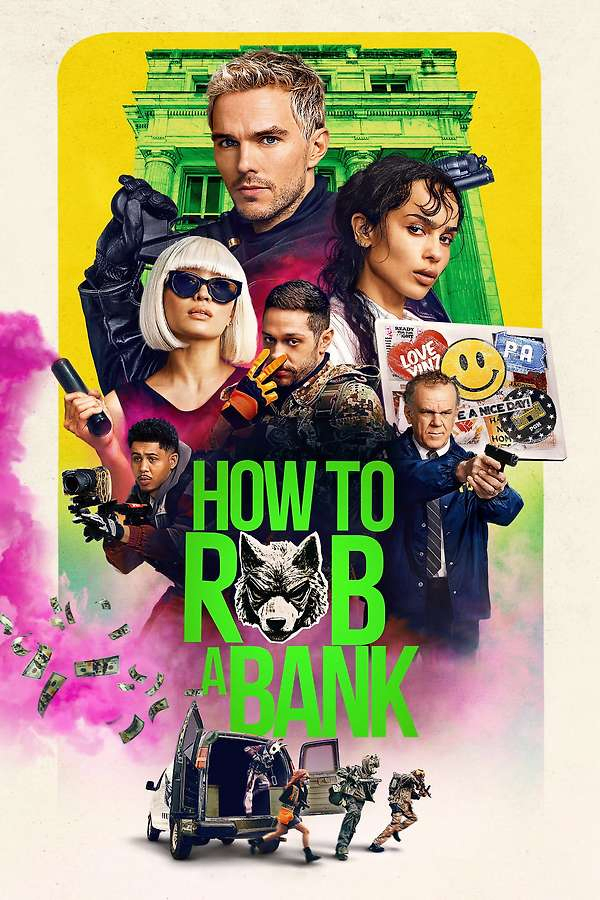
Released in United States cinemas on 13 November 2026, How to Rob a Bank brings a distinctly contemporary problem to the familiar heist thriller. Its criminals do not simply steal money and disappear. They turn their operations into online spectacles, allowing each successful job to expand their following while increasing the attention of investigators. The American theatrical opening is now part of the record, so the relevant question is no longer when an advance trailer might arrive. The continuing interest lies in the film itself: its cast, the mechanics of its premise, the choices behind its action sequences and the conversation it invites about visibility, trust and public sympathy.
Directed by David Leitch and written by Mark Bianculli, the film pairs a large ensemble with a story about the cost of becoming famous for doing something dangerous. Nicholas Hoult, Zoë Kravitz, Anna Sawai, Pete Davidson, Rhenzy Feliz, Christian Slater and John C. Reilly appear in the cast. The project comes from Amazon MGM Studios alongside experienced production partners. This article is a dated, spoiler-conscious examination of the theatrical release and its creative foundations, rather than a new announcement or an assessment pretending to be an eyewitness review.
The November theatrical release, clearly dated
The film reached United States cinemas on Friday, 13 November 2026, following a French opening earlier that week. Promotional material had previously circulated with a different September target, but that earlier calendar should not be mistaken for the completed theatrical release. The November date is the relevant historical milestone for readers following the film after opening weekend. Distribution and showtimes vary by country, so a local cinema listing remains more useful than an old trailer caption when deciding whether and where to watch.
Although the title appears on Prime Video's catalogue pages, the available listing describes the film as a theatrical release. A catalogue entry or trailer on a streaming platform does not establish that a subscription streaming premiere has occurred. An independently confirmed streaming start date was not part of the verified November 13 information. That distinction matters because readers frequently see a film on a platform's search page and assume it can already be played at home. For now, the confirmed release being discussed here is the cinema opening.
A heist story shaped by online attention
At the centre of the premise is a crew of robbers who document and broadcast audacious bank jobs. Their ability to attract an audience looks, at first, like a strategic advantage. Publicity can shape how outsiders interpret their motives and can turn an ordinary criminal investigation into a debate about which side deserves sympathy. Yet the same videos create evidence and patterns. Every attempt to control a public narrative also gives the authorities another opportunity to work out who is behind it.
The pursuing team combines two different kinds of expertise: a veteran federal investigator and a software engineer whose approach is rooted in modern digital traces. The contrast gives the film a clear structural engine. One side is committed to the excitement and mythology of its broadcasts; the other is trying to remove the spectacle and identify real people, locations and decisions. It is an accessible premise even for viewers who do not usually follow crime thrillers, because the dangers of oversharing and the incentives behind viral attention are immediately recognisable.
When a crowd becomes part of the plan
The social-media element changes the moral geometry of the story. A traditional robber wants fewer witnesses, while a robber seeking an audience wants attention without accountability. That contradiction creates suspense without requiring an elaborate explanation of banking procedures. A seemingly supportive online crowd may admire the apparent rebellion, but viewers must also consider what is missing from the carefully edited footage. Popularity, after all, is not a reliable measure of innocence or responsibility.
The set-up also raises an important question about the visual language of modern crime. A broadcast can make wrongdoing look like an act of performance. The film's creative challenge is to make that attraction dramatically understandable without confusing charisma with ethical justification. This tension is part of what makes the premise timely beyond the November opening. It concerns how people consume the imagery of public conflict, how quickly they form loyalties and how easily entertainment can overtake reflection.
An ensemble built around competing perspectives
Nicholas Hoult leads the central group, bringing the character of an ambitious robber into a cast that can alternate between action and uneasy humour. Anna Sawai and Rhenzy Feliz join that side of the story, while Pete Davidson adds another recognisable screen presence. The film does not depend on one isolated protagonist moving through anonymous set pieces. Its premise requires a network of collaborators, each of whom helps explain how a risky idea might become a sustained public operation.
John C. Reilly and Zoë Kravitz form a contrasting investigative partnership. Their characters bring different approaches to pursuit and information, which allows the story to place old-fashioned determination beside a more technical understanding of online behaviour. Christian Slater is also among the featured performers. The distribution of roles suggests that the film is interested not only in the physical chase but also in the competing calculations taking place on both sides. A full assessment of individual performances belongs in a separate critical review after direct viewing.
David Leitch and the demands of action storytelling
Leitch is associated with action filmmaking in which the staging of movement is a major part of the viewing experience. In this project, that sensibility meets a plot built around cameras within the fictional world itself. There is a difference between filming an action sequence for an audience in a theatre and depicting characters who are filming themselves for an audience inside the story. The two layers can reinforce each other, but they also require clear storytelling so that speed and spectacle do not obscure what the characters are trying to accomplish.
Mark Bianculli receives the screenplay credit, and the producing team includes Brian Grazer, Jeb Brody, Allan Mandelbaum, Kelly McCormick and Leitch. The collaboration brings together action-film experience and larger-scale mainstream production. Those credits are meaningful because a high-concept thriller needs coordination across script development, casting, physical production and editing. The premise may be summarised in one sentence, but sustaining it across a feature requires choices about pacing, dramatic reversals and the consequences of the characters' increasingly public behaviour.
Why the film has an identity beyond its opening date
Some release stories expire when the first weekend passes. This one still offers a useful conversation about the relationship between entertainment and digital culture. The criminals' public image is an essential element of their method, rather than a decorative reference to popular applications. That makes the film relevant to discussions of creator culture, audience manipulation and the speed with which online stories acquire heroes and villains. A reader discovering it later can still understand why these themes are central to its design.
The film also arrives within a long tradition of heist narratives that invite the audience to admire skill while questioning purpose. Familiar genre pleasures include planning, teamwork, escalating risk and the prospect that an apparently perfect scheme will unravel. How to Rob a Bank adds an unusual complication: the people carrying out the scheme seek the validation of spectators. Their quest for visibility may become as consequential as the money they hope to take. That idea allows a crime film to consider not just what a team does, but why it wants the world to watch.
A practical viewing guide without invented availability
The confirmed historical reference point is the November 13 United States cinema release. Readers outside that market should consult current local theatrical listings for their country. Promotional pages, advance-release calendars and territory-specific posters do not necessarily carry identical dates. Where two older marketing assets disagree, the updated distributor or cinema listing should take precedence over a date printed before the schedule changed. This is particularly important when international screenings are staggered rather than launched everywhere simultaneously.
No subscription-streaming premiere is asserted here, and no unverified box-office total is treated as a settled final figure. Both availability and commercial results can change as the run continues. Likewise, descriptions of a trailer or synopsis should not be mistaken for the experience of having watched and critically evaluated the finished film. These limits keep a release guide useful: it should tell the reader what can be confirmed and make clear which questions remain open.
What remains worth following
How to Rob a Bank is positioned at the intersection of an old cinematic form and a contemporary concern. Its ensemble, director and production credits are confirmed, its main premise is established, and its November 2026 theatrical release has already occurred. What remains uncertain for individual readers is the local booking situation and any eventual home-viewing timetable. Those are the details that should be refreshed when reliable new information becomes available, rather than rewriting the original opening as if it had just happened.
The film's lasting hook is the contradiction at its centre: people seeking both secrecy and mass attention. In a world where an audience can make almost any event feel larger, public recognition can become a powerful incentive and a serious vulnerability. Whether the finished drama succeeds at every artistic level is a matter for a properly viewed film review. Its release, however, offers a clear occasion to explore why a bank robbery conceived for the camera can also become a story about the camera itself.
PUBLISHED BY SUYASH PACHAURI, FOUNDER & OWNER, GLOBAL BOLLYWOOD | THE HOLLYWOOD SCOPE.