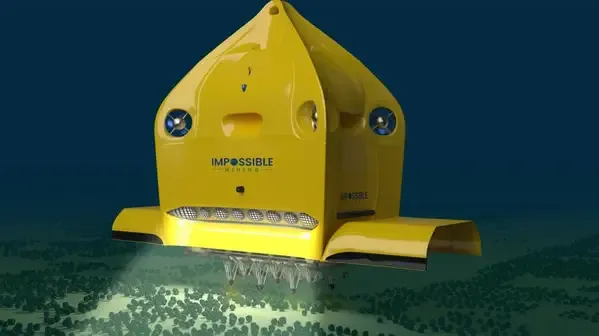
A small sample lifted from the Pacific Ocean floor has placed a difficult question at the centre of the critical-minerals debate: can machines recover valuable metals from the deep sea without causing the kind of widespread disturbance that scientists fear? On November 9, 2026, Impossible Metals announced results from a scientific expedition in which its autonomous Eureka robot collected approximately 450 grams of polymetallic nodules at a depth exceeding 4,000 metres. The dive itself took place in September, making the November disclosure the fresh development rather than a new expedition. The achievement is an engineering demonstration, not evidence that commercial deep-sea mining has become environmentally safe or economically viable.
A selective collection test in the Pacific
The trial took place in the Clarion-Clipperton Zone, a vast part of the Pacific seabed known for mineral-rich nodules. These naturally occurring formations contain metals including nickel, copper, cobalt and manganese. Their potential industrial value has made the region attractive to companies seeking alternative supplies of materials used across manufacturing and certain battery technologies. Yet the nodules also form part of an exceptionally slow-changing marine environment. For organisms living thousands of metres below the surface, a hard surface on an otherwise soft seabed can provide habitat that is difficult to replace.
What Eureka actually accomplished
The company says its machine travelled autonomously to the seabed, identified individual nodules, recovered a small research sample and returned to the surface. Rather than driving a heavy collector over the ocean floor, Eureka is designed to hover and use robotic arms to select particular objects. Its perception system is intended to recognise visible organisms associated with a nodule and leave that object undisturbed. A buoyancy-based lifting system is designed to move the payload upward without the long pumping pipe used in some competing concepts. These distinctions are central to the company's technological proposition, but each must ultimately be evaluated under repeated, independently monitored conditions.
Why the 450-gram sample matters
Four hundred and fifty grams is far too little material to establish the throughput needed for a commercial minerals operation. Its significance lies instead in demonstrating several connected functions during one demanding deep-water mission. A robot must navigate in darkness, withstand immense pressure, interpret visual information, position its collection equipment and return with a payload. Success at those tasks can justify further engineering investment. It does not establish how many machines would be required for profitable production, how frequently equipment would need maintenance or what a continuous fleet might do to the surrounding ecosystem.
The environmental question remains open
The idea of choosing individual nodules is different from collecting material indiscriminately, but selectivity does not remove every ecological concern. Visible animals are only part of deep-ocean biodiversity. Microorganisms and less conspicuous life may escape a camera-based screening system, while the nodules themselves can be living habitat. Removing even an apparently unoccupied nodule may alter the seabed. Scientists will need evidence about sediment disturbance, biodiversity, recovery times and the cumulative effects of repeated collection. A claim that a method is designed to reduce harm should not be confused with proof that it causes no harm.
A technology announcement, not a mining licence
Impossible Metals describes the September mission as marine scientific research. Commercial recovery is a separate matter requiring regulatory permission. The international framework for seabed minerals remains contested, and national approval pathways introduce additional legal questions. A successful demonstration cannot replace environmental assessment, transparent monitoring or the decisions of the relevant authorities. The company has indicated that results will inform a larger robot, but a future machine and a future permit are not present-day production capacity. Readers should distinguish the engineering milestone from the much longer process of establishing a legally authorised industry.
What the business model is trying to change
The company has promoted a model in which customers would obtain access to robotic collection services rather than necessarily building a conventional integrated mining system themselves. In theory, smaller autonomous units could allow operations to expand incrementally. The absence of a riser pipe could also change the cost and logistics of lifting material from the seabed. However, those possible advantages depend on practical realities that the scientific test did not measure: fleet reliability, energy consumption, recovery vessels, operating weather, maintenance intervals, processing arrangements and the cost of moving minerals to customers. None should be treated as settled merely because the robot completed one dive.
Investment interest adds another dimension
Alongside the technical announcement, the company disclosed investment participation by the family of FedEx founder Fred Smith in its Series A financing. It also identified In-Q-Tel among its investors. Such backing demonstrates that some investors consider the technology worth developing, but investor participation is not independent validation of environmental claims. Nor does a funding announcement determine the future market price of the recovered minerals. Commercial value will depend on regulation, mineral demand, competition from terrestrial extraction, recycling and changing battery chemistries. The financing story and the scientific story are connected, but they answer different questions.
What independent testing must establish
Future demonstrations need to go beyond whether a robot can pick up a nodule. Researchers should be able to examine how collection affects surrounding organisms, whether the system consistently avoids visible fauna and what happens to areas where nodules are removed. Environmental findings will be more persuasive when methods, measurements and limitations are available for independent scrutiny. Engineers, meanwhile, will need repeated missions at greater collection volumes to establish operational consistency. The strongest evidence would combine ecological monitoring with reliable data on actual collection rates and the cost of operating multiple vehicles over time.
The larger stakes for critical minerals
Governments and manufacturers are looking for resilient supplies of materials needed in industrial systems, transport and energy infrastructure. Deep-sea deposits therefore attract attention even as their exploitation raises unusually difficult environmental and governance issues. The debate is not simply a contest between technological progress and conservation. It is a question of what evidence should be required before an industrial activity expands into ecosystems that remain poorly understood. A more precise robot may change the available choices, but it cannot make that decision on behalf of scientists, regulators or affected communities.
A milestone with important limits
Eureka's reported recovery of a small Pacific sample gives Impossible Metals a concrete technical result to build upon. The distinction between a scientific sample and commercial mining remains essential. Selective collection could eventually offer a different operational approach, yet its ecological consequences and economics require much stronger evidence than a single successful expedition. The next chapter will be decided by independent testing, transparent data and regulatory scrutiny rather than by the novelty of the machine alone.
PUBLISHED BY SUYASH PACHAURI, FOUNDER & OWNER, GLOBAL BOLLYWOOD | THE HOLLYWOOD SCOPE.