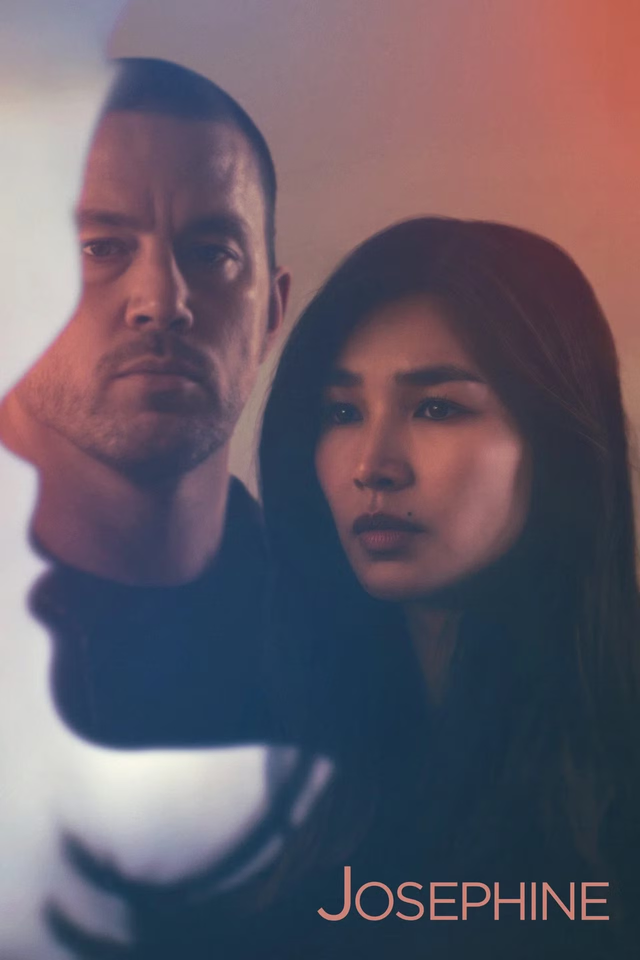
A Child Sees What She Cannot Yet Explain.
Josephine begins with a young girl witnessing a violent sexual assault while running in a park with her father. The event is presented through her limited understanding, making the film less concerned with procedural suspense than with the way incomprehensible violence alters a child's sense of safety. Mason Reeves plays Josephine, while Channing Tatum and Gemma Chan portray parents trying to help without agreeing on what recovery should require. The story's reported strength lies in refusing to give Josephine adult language or a clean therapeutic arc. She absorbs details, images and emotional reactions before she can organise them, and the film asks viewers to recognise intelligence within confusion rather than waiting for a speech that explains everything.
Mason Reeves Holds the Perspective
Reeves carries a demanding role through observation and behaviour. Josephine's fear appears in altered routines, sudden defiance and an imagination that keeps returning the attacker to her private spaces. The film reportedly visualises that intrusion without turning it into a conventional horror device. He becomes a figure she cannot stop seeing, part real memory and part mental construction. By staying close to Josephine, the direction limits what audiences know about the adults' private decisions. That choice keeps the child's experience central and prevents her parents from taking over the narrative with well-intentioned explanations. Reeves must communicate recognition, confusion and anger at once, and the performance has been singled out for unusual precision.
Parents Divided by Love and Fear
Tatum's Damien believes confronting danger and participating in the legal process may help restore control. Chan's Claire worries that pressure will deepen the injury and wants to protect her daughter from further exposure. Neither position is treated as entirely wrong. Their disagreement reveals how love can produce conflicting instincts when adults cannot guarantee safety. Damien's anger at the attacker and Claire's sensitivity to gendered threat also emerge from their own histories. The film reportedly gives Chan room to suggest earlier experiences that influence how Claire responds. These layers prevent the parents from becoming simple obstacles or moral guides. They are frightened people trying to make choices for a child whose inner world they can no longer fully read.
A Court Case Without Easy Resolution
The request that Josephine assist the prosecution turns memory into evidence and forces the family to consider what justice demands from a child witness. The film does not appear interested in courtroom triumph or punishment as an emotional cure. Its larger question is how a person continues living in a world where ordinary places can contain sudden violence. An ambiguous approach to the legal outcome supports that focus. Viewers are asked to consider dignity, safety and agency rather than waiting for a verdict to settle the story. That decision may frustrate audiences seeking closure, but it aligns with a film that treats trauma as a long-term change in perception rather than a problem completed by one institutional result.
Compassion Without Sentimentality
Josephine's sober tone is reportedly balanced by visual imagination and a strong understanding of family intimacy. The camera searches rooms and circles environments as if sharing the child's need to identify possible threats. At the same time, the film avoids exploiting the assault for suspense. Its tension comes from the consequences: school behaviour, pregnancy news within the family, arguments between parents and Josephine's effort to rebuild trust in ordinary life. The result is a drama that offers compassion without promising restoration to a previous, untouched self. Survival here means learning how to live with knowledge that cannot be removed. By respecting Josephine's perspective, the film turns that difficult idea into an act of empathy rather than despair.
The Film's Ethical Challenge
Portraying sexual violence through a child's perspective requires exceptional restraint. The camera must communicate what happened without turning the victim's suffering into an image designed for excitement. The reported response to Josephine suggests that the film keeps its attention on perception and consequence, allowing the initial event to establish the wound without repeatedly exploiting it. That ethical discipline continues in the way the attacker appears in Josephine's imagination. He is not transformed into a fascinating villain; he remains an intrusion that reveals how memory can occupy safe spaces. The approach makes the family's ordinary activities carry tension while preserving the survivor's humanity. It also asks adult viewers to recognise how much children notice even when they lack the language adults expect them to use.
Parents Without Perfect Answers
The restrained approach gives the adult performances additional weight. Tatum and Chan cannot solve the plot through force or eloquence; they must show parents learning that protection has limits. Their uncertainty makes the family credible and prevents the film from suggesting that perfect responses exist after trauma. What matters is whether they remain attentive enough to change their approach when Josephine's behaviour tells them that their first ideas are not working.
Josephine treats a child's fear with rare patience, finding moral clarity without pretending trauma offers easy answers.
PUBLISHED BY SUYASH PACHAURI, FOUNDER & OWNER, GLOBAL BOLLYWOOD | THE HOLLYWOOD SCOPE.