THE FILMMAKER’S EYE
In Satyajit Ray’s Bengali debut, Apu gets to see his first train. His older sister is the one who tells him when to listen.
When the train is still somewhere beyond the flowers, Durga puts a hand over her little brother’s mouth. Anybody who grew up with an older sister knows that hand. Apu has a question. She needs him to be quiet. Give him an answer and he may ask another. Hush him and, for a few seconds, both of them can hear what she has heard.
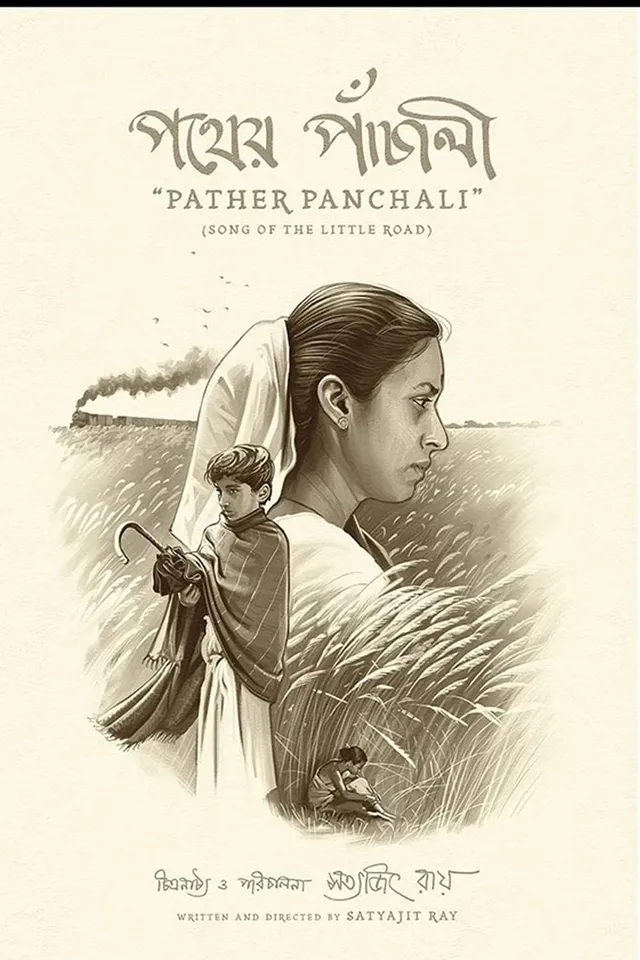
Try remembering the train sequence in Satyajit Ray’s Pather Panchali from that point. The picture that usually gets pride of place is of a small boy, a black train and a field of white flowers. Yet the person who makes the encounter possible is the girl who falls on the way to the tracks. How did one child’s discovery come to look so much like the other child’s story?
Durga has done something like this before. Earlier in the film she picks out a faint bell. The sweet seller is coming. She sends Apu to ask their father for money. He comes back empty-handed, so the children follow the man anyway. A dog falls in behind them. Seen in the pond, their little procession makes a glorious outing of an unsuccessful shopping trip. Durga has a talent that any younger brother would value. She can find something to do on a day when there is no money to do it.
In the field, that talent comes with a small inconvenience for Apu. The white kaash grass is high enough for Durga to disappear into. Before he can locate a locomotive, he has the more pressing business of locating his sister. A child can be quite brave about going to the ends of the earth provided the person who brought him is somewhere within calling distance. Ray allows Apu the indignity of being the younger one.
There is already something worth hearing in the wires overhead. Durga puts her ear to a pole. It makes perfect sense to a child that getting closer to a thing might explain it. Here is the modern world arriving in rural Bengal, and the first practical question it raises is where to put your ear. When Durga later hears the engine, watch Uma Das Gupta’s hand. She gives the girl an older sibling’s confidence in her right to interrupt. From the instant she hushes Apu, the audience is listening on her instructions, too.
Ray had to work surprisingly hard for Apu’s air of distraction. He later recalled that on the first day of shooting, Subir Banerjee had difficulty walking naturally through the field while looking for Durga. Ray gave him small obstacles to step over. Three assistants, stationed apart, called to him in turn. Now the boy had somewhere to put his feet and a reason to turn his head. What looks on screen like a child making up his mind from moment to moment depended on several adults knowing exactly where to stand.
There’s a pleasure in seeing the scene again once you know that. Somewhere outside the frame, a grown-up has just called to Subir. Within it, a little boy looks up in the hope of finding his sister. Both things can be true in the same tilt of his head.
Then the children run. Durga stumbles. Apu gets far enough to see the carriages go by, and for once the younger child has got ahead. Ray lets him have the whole astonishing sight. He also leaves us with a little piece of unfinished family business. We know whom Apu would ordinarily turn to with his questions about what he has just seen. She is the one person missing from his side.
In Aparajito, the second film, Apu is old enough to buy a ticket. After a visit to his mother, he goes to the station to return to Calcutta. The train arrives. Apu lets it go, comes home and pretends he missed it. Once, getting to the tracks in time was everything. Now he knows what it would mean to someone if he came back.
Return to the field after that scene and Durga’s hand takes on an extra tenderness. She has heard something marvellous. She wants her brother to hear it while there is still time. Anyone who has ever grabbed a sibling’s arm at the cinema just before a favourite moment knows the impulse. The pleasure begins a second earlier for the person who gets to say, listen.
PUBLISHED BY SUYASH PACHAURI, FOUNDER & OWNER, GLOBAL BOLLYWOOD | THE HOLLYWOOD SCOPE.