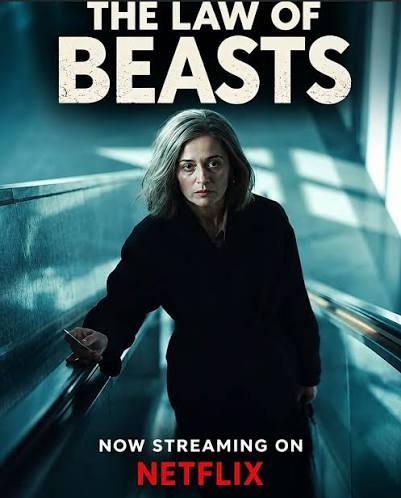
Why the November 11 Trailer Still Matters
The November 11, 2026 trailer announcement for The Law of Beasts was an important final introduction to a Polish drama that reached streaming audiences on November 18. Its value now is not the announcement itself, which is already historical, but a clearer understanding of the four-episode series, its unusual two-period construction, and the ethical questions that make it worth examining after release.
At a time when crime series often emphasize surprise revelations, this drama places the consequences of official decisions at its centre. The case connects an investigation in 1988 with the possibility of a convicted killer leaving custody roughly a quarter-century later. The suspense is therefore about accountability, institutional responsibility and competing ideas of justice, rather than only the identity of a perpetrator.
The Story Across Two Periods
The drama begins with Major Anna Bersz investigating the murders of four boys in Poland in 1988. Her friend Agnieszka Grabska, a psychiatrist, must assess the suspect's mental state. Their tasks appear aligned, yet the professional standards expected of an investigator and a psychiatric expert can lead them toward different conclusions under pressure from the authorities and the public.
The second period returns to the dispute around the convicted man's anticipated release in 2014. Anna has moved into public service, while Agnieszka has established a career in psychiatry. Both must confront the historical case and the personal cost of choices made earlier. In this structure, unresolved feelings are not merely background material; they help explain how public decisions reverberate through private lives.
A True-Event Inspiration With Fictional Protagonists
The series draws inspiration from the real Mariusz Trynkiewicz case and debates surrounding Polish legislation commonly associated with the Beasts Act. That connection deserves careful handling. The programme is a scripted drama, not a documentary reconstruction, and its central friendship between Anna and Agnieszka is fictional. Viewers should not assume that private dialogue or every dramatic encounter reproduces a historical record.
Separating historical inspiration from dramatization is especially important when a story involves murdered children, psychiatric assessment and the limits of criminal punishment. The background establishes why the subject became socially divisive, but the storytelling uses invented perspectives to explore difficult institutional judgments. Understanding that distinction allows audiences to assess the drama without confusing its character psychology with verified testimony.
The Two Women at the Centre
Agnieszka Grochowska portrays Anna Bersz, whose investigative role develops into a position of government responsibility. Anna believes society must remain protected from grave harm and struggles to accept uncertainty in a case with exceptionally high stakes. The character's convictions give the narrative a firm moral centre while raising questions about whether personal certainty can substitute for a sound legal process.
Agnieszka Żulewska plays psychiatrist Agnieszka Grabska, a professional asked to offer an evaluation despite expectations that may push toward a predetermined outcome. Her character approaches human behaviour through a more complicated clinical lens. The resulting difference is not simply a conflict between compassion and punishment; it is about which responsibilities professionals owe to the public, the law and the integrity of their disciplines.
The Convicted Man and the Supporting Ensemble
Michał Pawlik portrays Mariusz Trynkiewicz, the convicted figure whose impending release reactivates earlier conflict. His presence is central to the questions the drama asks, although the focus extends beyond the individual offender to those required to make consequential decisions about him. The production avoids turning the story into a straightforward contest between a detective and a suspect.
The wider cast includes Kamilla Baar, Adam Nawojczyk, Michalina Łabacz, Aleksander Talkowski, Jakub Sasak, Jan Jankowski and Andrzej Chyra, alongside other Polish performers. Those additional roles broaden the institutional and personal settings around the two leads. This ensemble framework is useful for viewers who favour complex dramas in which no single person controls the social consequences of a case.
Direction and Screenwriting Approach
Kasper Bajon directs the four-part production and co-wrote it with Anna Kasińska. Its compact length provides room for the past and present timelines to illuminate each other without requiring a long season of procedural detours. The underlying design appears to be character-driven: the investigation establishes a rupture, while the later controversy tests whether the central relationship can ever move beyond it.
The creative approach also places women with distinct professional responsibilities at the heart of decisions that institutions frequently discuss in abstract language. By linking a police investigator and a psychiatric specialist, the story can examine the same legal dilemma from competing but serious viewpoints. That structural choice gives a familiar true-crime premise a different dramatic emphasis.
Production Details and the Four-Episode Format
The series was produced by Edyta Krajewska through Entrego, with cinematography by Bartłomiej Kaczmarek and music by Piotr Waglewski. Its original announcement identified four episodes and an approximate 45-minute episode length, although the streaming catalogue now displays individual runtimes that vary, including a longer final instalment. The updated episode listings should take precedence over an early general runtime estimate.
All four episodes became available on November 18, 2026. A complete season of this scale is accessible to viewers seeking a focused, self-contained drama rather than a lengthy procedural. The dual timeline and legal themes reward careful attention to changing professional circumstances, especially when characters' present-day positions alter how they remember past choices.
Why the Moral Questions Are Difficult
The story asks what should happen when a criminal sentence approaches its conclusion but public fear remains acute. A legal system is expected to follow clear rules, while public officials must also consider safety. Psychiatric expertise operates under a different obligation: professionals should provide assessments rooted in their discipline rather than delivering conclusions tailored to political demands.
These responsibilities can collide without one side becoming automatically dishonest or uncaring. The drama derives much of its force from that uncomfortable overlap. It also raises an important viewing question: how can institutions respond to extreme wrongdoing without abandoning the procedural principles intended to protect everyone? The series supplies a fictional setting for considering that issue, not a definitive answer.
What Audiences Can Watch Now
The Law of Beasts is now listed for streaming as a four-episode Polish drama. The catalogue identifies Agnieszka Grochowska, Agnieszka Żulewska and Michał Pawlik as its leading performers and classifies the show among crime, psychological and socially grounded dramas. Availability of particular audio and subtitle languages can differ by territory, so viewers should consult the title's own playback options before starting.
Those expecting a conventional detective mystery may be surprised by the attention to friendship, professional ethics and the politics of public protection. The series is more appropriately approached as a fictional exploration of the long afterlife of a criminal case. Its sensitive subject matter, including harm to children and the prospect of an offender's release, makes it better suited to mature audiences.
Final Perspective
The November 11 trailer remains a useful historical marker because it clarified the creative team's priorities one week before the series launched. Rather than preserving that announcement as fresh news, this guide places it alongside the completed November 18 release and the streaming service's present episode information. It also corrects the misleading impression that characters invented for a drama must correspond to real participants in the underlying case.
For viewers interested in international storytelling, The Law of Beasts illustrates how a short series can connect crime, memory, institutional power and the fragile bonds between colleagues. The lasting subject is not a launch-day promotional moment but the continuing question of how justice and public safety should be weighed when there is no easy decision available.
PUBLISHED BY SUYASH PACHAURI, FOUNDER & OWNER, GLOBAL BOLLYWOOD | THE HOLLYWOOD SCOPE.